
Celebrating national costumes and their historic contexts is one way to preserve a country's heritage in an increasingly diverse global community. For some, national heritage days at school let people show-off their ancestral apparel with pride, while others learn about it through social media.
In a divisive international environment, uplifting these unique pieces of material culture that represent just one of the many pieces of our shared histories as human beings living on Earth can be an incredibly moving thing. Learn more about the cultures that are oceans away from you by exploring their national dress.
Mexican Mariachi Apparel

Once a sprawling country spanning North and Latin America, Mexico couldn't possibly be pinned down to just a single style of national clothing. One of the most popular is the Charro suit and sombrero ensemble most often worn today by Mariachi bands. The suit consists of a heavily embroidered jacket and matching pants often worn over a cotton shirt. It can come in a beautiful array of colors.
Mexican Huipil

Another unique cultural dress that indigenous Mexican and Guatemalan women in particular love is the huipil. The huipil consists of a loose, rectangular garment with a hole at the top for your head to go through. Depending upon the length, it can be worn loose, or tucked into a skirt and belted. The huipil is made of very light, sheer cotton and is meant to be comfortable to wear. Today, it's expanded in style and can include separates as well as the more traditional single-piece garment.
Austrian and Bavarian Lederhosen/Dirndl Outfits

Austria and Bavaria have close cultural ties, so naturally they'd share a traditional dress. If you've ever visited an Oktoberfest, you've definitely seen adaptations of the customary lederhosen and dirndl. Lederhosen is a traditional costume for men consisting of leather shorts, suspenders, and natural-fibered shirts. Dirndls are worn by women, and typically came in three pieces: dress, blouse, and apron.
On both dirndls and lederhosen, you can find exquisite embroidered folk imagery as well. While they used to be common among working-class men and women, they're now reserved for festivals and special occasions.
Traditional Grecian Costumes

You don't have to stretch back to Ancient Greece to find beautiful national costumes. Rather, more recent traditional dress shows influence from their central European neighbors' folk costumes with their saturated dyed fabrics, multiple layers, and native textiles.
Greek men's national costumes include the fustanella, which is a pleated skirt with a white shirt, and the vraka, a white shirt paired with loose trousers. Similarly, there are multiple pieces needed to complete a woman's costumes; the poukamiso is a foundational chemise layer that the aprons, bodices, vests, and scarfs are built on top of.
Romanian Folk Costumes

No, you won't find Romanians breaking out their vampire capes when they go to pull out their national costumes. Rather, their traditional dress is steeped in a deep Eastern European folk style that highlights their textile arts, bright clothing, and simple silhouettes. Because there are so many strong regional communities, there isn't one single costume.
But there are a few seminal pieces throughout the area you can admire. For example, a woman's 'le' is a three-part decorated shirt that highlights their national embroidery styles.
Traditional Finnish Costumes

Although it's gone through small changes over the years, the fundamentals of Finnish traditional costumes were established in the 1500s. For women, it consists of a long, loose skirt worn with a loose cotton blouse and a vest or short jacket. For special occasions, scarves and headgear are added. Meanwhile, men wear knee-length trousers, shirt, vest, and long socks.
Russian National Costumes

Like so many countries on this list, Russia's traditional dress was made to honor their artistic abilities, natural color palettes, and weather conditions. These national costumes represent a marriage of function and form, being loose to allow people easy movements.
According to the Museum of Russian Art, everyone wore traditional dress until Peter the Great introduced western apparel in his own initiative to modernize the country. There are two major types of ethnic dress. The sarafan consists of a linen shirt and loose jumper dress worn over the top and belted, while the poneva is composed of plaid or striped gathered skirt, loose embroidered shirt, paired with a colorful apron over the top.
Traditional Scottish Outfit

If you're one of the millions of Outlander fans, then you're very well aware of the unique cultural costumes the Scots have worn throughout history. The knee-length pleated kilt is immediately recognizable as Scotland's most popular cultural costume. What makes this even more special is the practice of using the family tartan (the patterned fabric) to show the world where you came from. A sporran, a furry pouch worn around the waist, and knee socks are other classic parts of this Scottish costume.
Uzbek National Clothing

Uzbekistan is located in Central Asia, and their national costumes bear a striking resemblance to their neighbors'. Uzbek women's traditional dress consists of a long, loose, colorful tunic over loose-fitting, gathered pants. A coat in complementary colors is often added. Uzbek men's is made up of a long, loose robe, called a chapan, adorned with a decorative braid.
Also, to keep your head from getting cold, you can wear their national headdress - the Tyubeteika. It's a unisex soft-cap that's made in so many unique patterns and embroideries.
Traditional Dress of Morocco

While exploring the beautiful North African country of Morocco, you'll find many different styles of traditional dress. Both Moroccan men and women often wear the djellaba, a long, hooded robe with long, full sleeves. In some regions, this robe is more than just decorative; it is also used to convey marital status.
Additionally, the caftan (which has long since been co-opted by the west) made of high-quality fabrics and embroidery can be seen across the country.
Japanese Traditional Dress

One of the most well-known (and also co-opted by the west) East Asian dress styles is the Kimono. The Kimono is the unisex national dress of Japan, worn on formal occasions. It consists of a long undergarment called a nagajuban, a sash called an obi, the obiage, which holds the obi up, baggy sleeves, and a richly colored overdress.
Norwegian Bunad
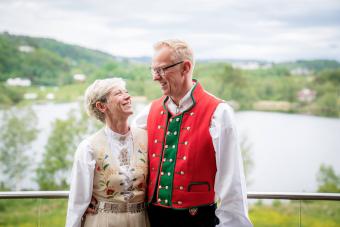
Much like other Scandinavian countries, Norway's traditional folk costumes show off their people's incredible embroidery skills. One of these folk outfits is called a bunad, with is a dress or coat made out of saturated, dyed wool. Worn over a white, billowing shirt, you could add other folk items to it like aprons, bodices, or headscarves. Given the climate and native animal population, wool was a major fabric used by historic Norwegians. Naturally, men's folk outfits were made out of the material too.
Zulu Traditional Dress

In the Zulu culture, the traditional male dress consists of the amashoba, which are cow tails worn on the upper arms and lower legs, the IsiNene or front apron which is made of skin patches, and the ibeshu or rear apron, which is made of calf skins.
Meanwhile, women wore beautifully patterned fabrics tied around their bodies, and married women covered their heads with the izicolo, a notable circular conical hat.
Baiana Women of Salvador's Traditional Ensemble

Salvador, Bahia is a Brazilian municipality and was, at one time, the capital of Brazil. Naturally, a country as regionally varied as Brazil would have multiple different traditional costumes, but the bahian found in Salvador is a wonderful example.
The traditional Bahian dress consists of a turban, bright skirts that are heavily starched, a shawl over the shoulders, and a large amount of jewelry such as bracelets and necklaces. The costume serves as a reminder of the country's shared European, African, and indigenous heritage.
Seminole Traditional Clothing

The Seminole are an indigenous American tribe with regional ties to Florida. Their traditional clothing is extremely colorful, made up of a patchwork of strips of color and cloth.
Seminole women traditionally wore a floor-length skirt, tied at the waist with a blouse that had an attached cape. They also bought strings of glass beads over time and wore as many as they possibly could. According to the Seminole Tribe of Florida's website, this wasn't for ritualistic purposes but rather a combination of custom and vanity.
Meanwhile, Seminole men wore a simple, full-cut shirt with a colorful coat embellished with ruffles over it during the cold months.
Traditional Aleut Coat

The Aleut are a lesser-known indigenous people who were relocated to the Commander Islands in the Bering Sea by their Russian occupiers. Because of the cold climate they live in, their national dress has to be full of warm clothing. Traditionally, the Aleut people would wear fur-lined parkas (tunic-like coats) that went below the knee. They'd pair these parkas with brodni (sea lion trousers) and torbasa (waterproof boots). The Aleuts are a great representation of how your environment can inform what you wear and how you wear it.
Chinese National Apparel
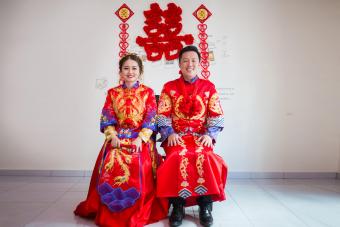
Alongside the Kimono, Chinas's cheongsam dress is one of the most recognizable national ensembles from the East. This tailored, well-fitting dress of silk or satin fabrics is typically buttoned up to the neck in a short collar, later termed the Mandarin collar in western apparel. Men wear their own version of the outfit called a changshan, which looks like a long shirt.
If you look back through the decades, you'll see how often the western world has taken these East Asian dress styles and turned them into a mockery. As with so many other national outfits, it's important to remember that these things are culture and not costume.
Traditional Hmong Clothing

The traditional dress of the Hmong people varies dramatically based upon which tribe is wearing it. The Flower Hmong, for example, wear brightly colored and richly embroidered clothing, which often has a beaded fringe. The outfits are worn in layers such as a jacket that wraps across the shoulders, or a tunic worn over a long-sleeved shirt. Girls and woman typically wear brightly patterned skirts as well.
Sign up for our newsletter featuring all the latest stories and products we love.
Traditional Clothing of India

Long before British occupation, India was creating impeccable textiles and outfits for their national consumption. These outfits were regionally distinct and have developed into a broader national style. For women, this consists of a sari, a long piece of cloth usually heavily embroidered or patterned, draped over a simple or fancy blouse. Men wear long sheets of white cloth known as a dhoti over a t-shirt or other comfortable clothing. The most distinctive parts of these outfits are their decorations and bright colors.
Ukrainian National Dress
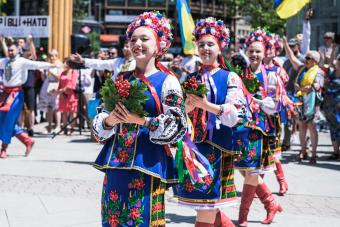
The national clothing for men and boys in the Ukraine consists of a shirt that is embroidered down the front and around the cuffs. This is paired with loose, often satin or highly decorative pants and tied at the waist with a brightly colored cloth.
Women and girls in the Ukraine also wear heavily embroidered blouses, often with a coordinating vest or jacket on top. This is paired with a colorful, full skirt that may feature matching embroidery or patterns found on the blouse and jacket.
Indigenous American Pow Wow Apparel

With so many different tribes, the American indigenous community can't be reduced to a single outfit. However, one place they still showcase their heritage, ancestry, and culture is at pow wows. There are a multitude of different dances that can be performed, and each comes with a traditional costume.
One of these is the Jingle Dress/Prayer Dress. These colorful dresses are stitched with metal cones that clack together as the jingle dancers perform their routines.
Another is the Fancy Dance ensemble. Originating with the Hethuska Society in Oklahoma, this dance is one of the most popular performed at modern pow wows. In the massive plumed outfits you'll find are beaded accessories (headbands, armbands, belts, etc), breastplates, and feather bustles, among many other things.
Arabic Women's National Dress

Many Arabic countries share a national dress style thanks to their interconnected cultural and religious heritage. Because of their deep Muslim roots, women's national dress amounts to a full-body garment called the abaya. The abaya is a long square of cloth that's draped across the head and shoulders around the body and to the feet. The purpose is to cover every part of their body aside from their face to honor and abide by Muslim principals.
Arabic Men's National Dress

Similarly to the abaya, although less covering, is Arabic men's thawbs. Thawbs are long, long-sleeved tunics with stiffened collars. Yet, these simple outfits become highly personalized with the colorful and detailed embroidery that's sewn into the collars, cuffs, and fronts. The more heavily embroidered, the more expensive your thawb is going to be.
Korean National Dress

For well over 1,000 years, Korea has held onto a beautiful national ensemble called the hanbok. This traditional dress is worn in festivals, celebrations, and other special occasions. For women, the hanbok amounts to the jeogori, or long-sleeve blouse/jacket, and a chima, or voluminous skirt that sits high on the ribcage. In contrast, a men's hanbok consists of a longer top with loose-fitting pants known as paji. Made out of colorful and sumptuous fabrics, these outfits immediately call back to a bygone era.
Traditional Vietnamese Clothing

Vietnam has a complicated history full of western colonization and war, but the beautiful culture that's come out of it needs to be celebrated. One of these things is their traditional clothing, called the ao dai. An ao dai is a unisex silk tunic that's been modernized and updated to fit contemporary fashion standards. Unlike other traditional outfits, the ao dai continues to be a popular formal wear choice for Vietnamese.
Clothes Can Connect the Past With the Future

National costumes reflect individual cultures and help forge an appreciation for what makes each nation unique. Whether it is for an ethnic festival, a school report, a touring national dance troupe, or to honor your cultural roots, a national costume is a great way to express a connection to a specific nation, as long as you wear it in a respectful manner.


